
Artist Spotlight: Nicola Slattery RBA
/ Royal Society of British Artists
Q&A with Nicola Slattery
We had the pleasure of speaking with member of the Royal Society of British Artists, Nicola Slattery. A painter and printmaker, her artistic vision explores an imagined harmony between humanity and nature.
Hi, Nicola! Please introduce yourself and your artistic background.
Growing up on a council estate in Coventry in the 60s and 70s I saw a lot of concrete and tarmac and not many green fields or hedgerows. I used my imagination to create images of other worlds. Graduating from Coventry Art School in the 1980s with a BA in Fine Art, I moved to Oxford to join the Oxford Printmakers Coop in 1986. Since 1995 I have lived and worked in Norfolk and am pleased to now be able to live amongst green fields and hedgerows.
My work is now based on painting with acrylics. Figurative narrative images emerge from an imagination developed in my youth. I regularly return to printmaking using the drypoint and collagraph techniques learnt at art school. I enjoy teaching and sharing techniques and approaches with others and continue to offer a few weekend art courses each year. The interaction with a small group of people contrasts with the solitary nature of working in my studio. Exhibiting at art fairs for similar reasons, I value the direct feedback they provide. Something similar happens with openings at galleries although in a more limited way.
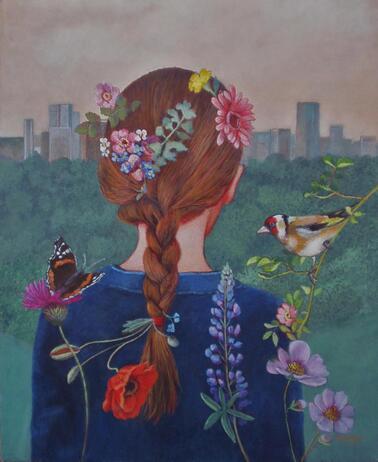
How do you approach the balance between dream and reality in your artwork? For instance, your work 'City Dreamer' presents a girl covered in flowers and birds, looking at a grey city in the distance. Without revealing all its secrets, can you share some insights about this work?
Reality has never been a priority in my work. For example, I view rules such as perspective and light direction as useful guidance but not for obedience. In some of my work figures float freely in the sky. When the laws of gravity are broken the imagination can also break free. In City Dreamer you can see echoes of my childhood imagination. Am I looking back from the fields of an imagined country idyll or dreaming of a return to my childhood years? I like to visit London, Manchester and other cities for the cultural aspects and change of pace they provide but find a day or two is enough before being lured back to the countryside.
In much of my work I try to convey an imagined harmony between people and nature which sadly is often lacking in reality. I believe, however, that we first need to imagine a better world if we are to be able to create one. I hope that my work contributes something towards this.
In much of my work I try to convey an imagined harmony between people and nature which sadly is often lacking in reality. I believe, however, that we first need to imagine a better world if we are to be able to create one.
In your printmaking, you use hand printmaking techniques. Could you explain what these techniques involve and why you find them important in your work?
The two techniques I use for printmaking are collagraph and drypoint. Collagraph prints are taken from a plate based on cardboard into which the line is cut with a scalpel or relief is added by gluing items to the surface (e.g. lace, tissue and similar materials). The plate is inked and passed through a press with damp paper to transfer the image and create the finished print. With drypoint a plate is created with metal or perspex sheet into which the line is incised with a steel needle or "drypoint". The plate is then printed from in a similar way to collagraph. I use perspex as it is softer, producing a velvety line and both techniques produce a very definite "limited edition" as the plates wear out after only around six to twelve good prints.
Sometimes I develop an image or idea through printmaking or painting which subsequently I want to develop further in another medium. This shift between the techniques and medium can often help the idea along and I enjoy painting and printmaking in the same way that a cook might enjoy cake baking and pie making. As prints are more affordable, they open up fine art collecting to people who might not be able afford a painting. I hope this brings my work to a wider audience.
Your art has previously been used for poetry book covers, can you explain the relationship between your art and poetry?
"Painting is silent poetry, and poetry is painting that speaks." Plutarch - Greek Philosopher
Poetry combines imagination and narrative in a similar way to my artwork and perhaps this explains the relationship. Poetry can be ambiguous suggesting some elements of the story whilst leaving others to the imagination. I think my paintings and prints do something similar. Interpretations will vary from one person to another and even the same person will see different things depending upon their changing moods. As well as appearing on poetry book covers, several poets have responded to my work expressing in poetry, the unique meaning they have found in an image.
Your work seems quite esoteric and reminds me of the themes and aesthetics explored by symbolist artists of the late 19th century in Europe, such as Gustav Klimt, Gaston Bussière and Odilon Redon - who also worked closely with poets. Would you say that this art movement has inspired your practice? Are there any other influences you would like to share?
People often search for meaning in art and find different things depending upon differing backgrounds, preconceptions and experiences. These differ and more than one thing can be true at the same time. Art is very personal. Artists often respond to feelings which are not fixed or clear. In creating a work they might be exploring and reacting to something rather than setting down fully formed and complete ideas. Sometimes I create a work with one idea in mind but realise later that something else was going on. Other interpretations emerge. Others find meaning in a work which may have been unintended, but which is no less relevant for them.
Many artists have inspired me. From medieval monastic paintings, often by unnamed women artists, through to the twentieth century it is difficult to single out specific names. The Dutch, from Vermeer to Van Gogh, have produced figurative narrative work which feeds my imagination and so many others from across the sea such as Edward Hicks, Frida Kahlo and Grant Wood to name a few. Others nearer home include Samuel Palmer, Stanley Spencer, Gabriel Rossetti. Also Paula Rego, I was privileged to exhibit some work alongside her prints in my early years.
Image credits
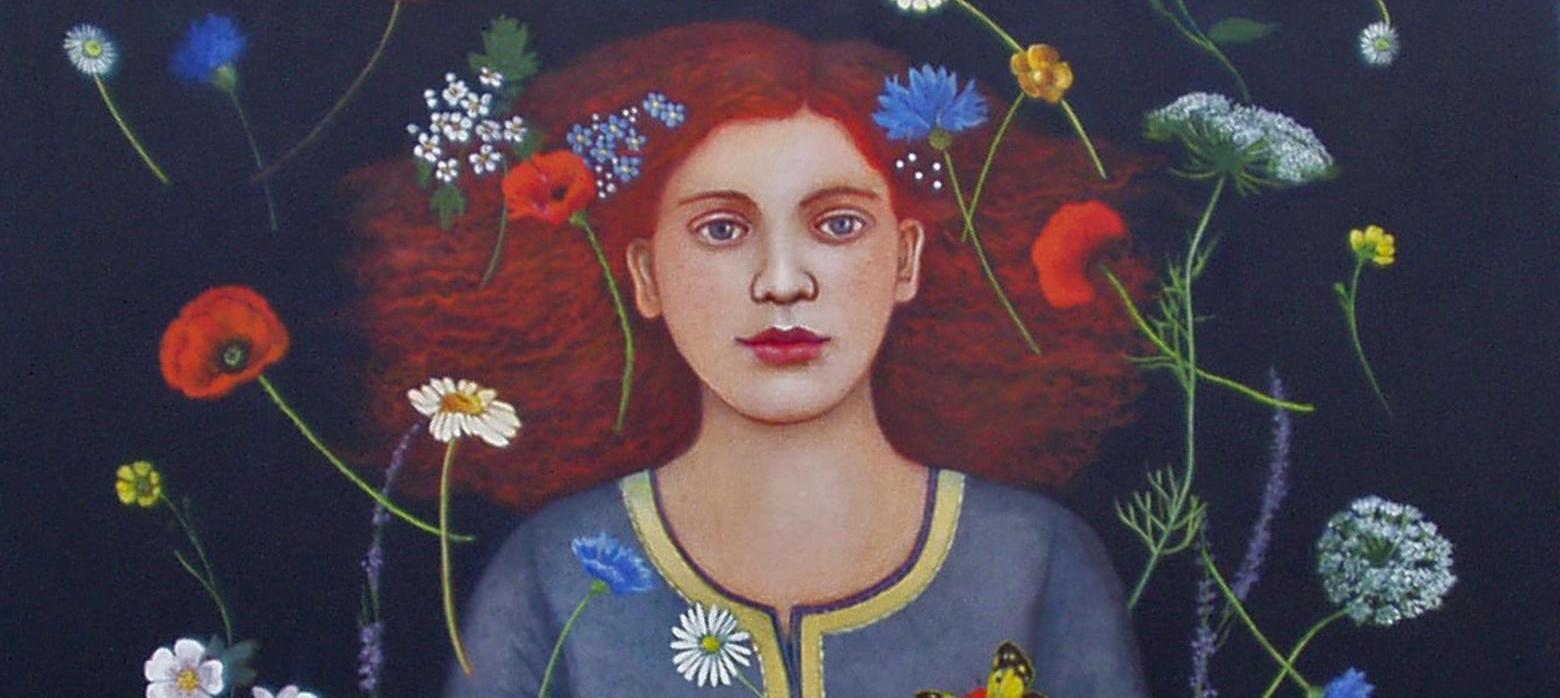
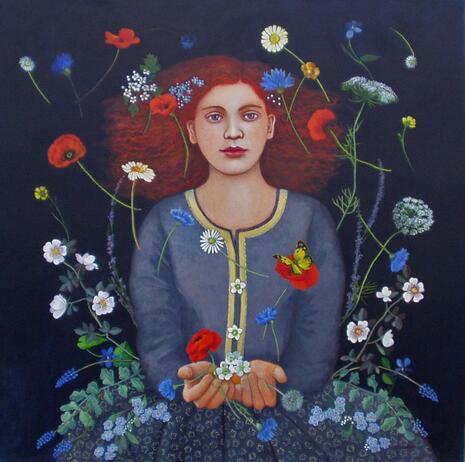
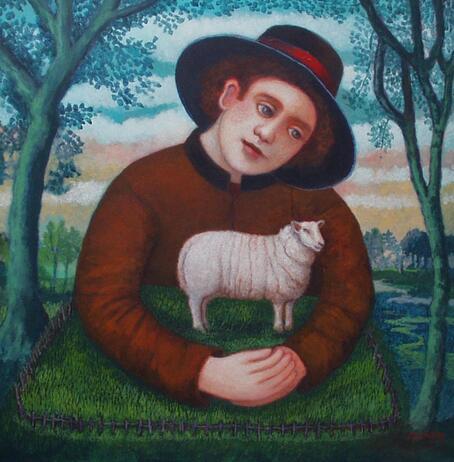
Images (top to bottom): Nicola Slattery, Falling Flowers | Nicola Slattery, City Dreamer | Nicola Slattery, Young Shepherd