Interview: First-Time Exhibitors at the Pastel Society Annual Exhibition 2026
/ Pastel Society
Each year, the Pastel Society hosts an open call to identify and support talented artists working in dry media. The Pastel Society exhibits the work of selected artists as well as members at its annual exhibition, in order to demonstrate the breadth of possibilities when working with dry media and spotlight emerging artists. We have interviewed a few such artists, all first-time exhibitors with the Society.
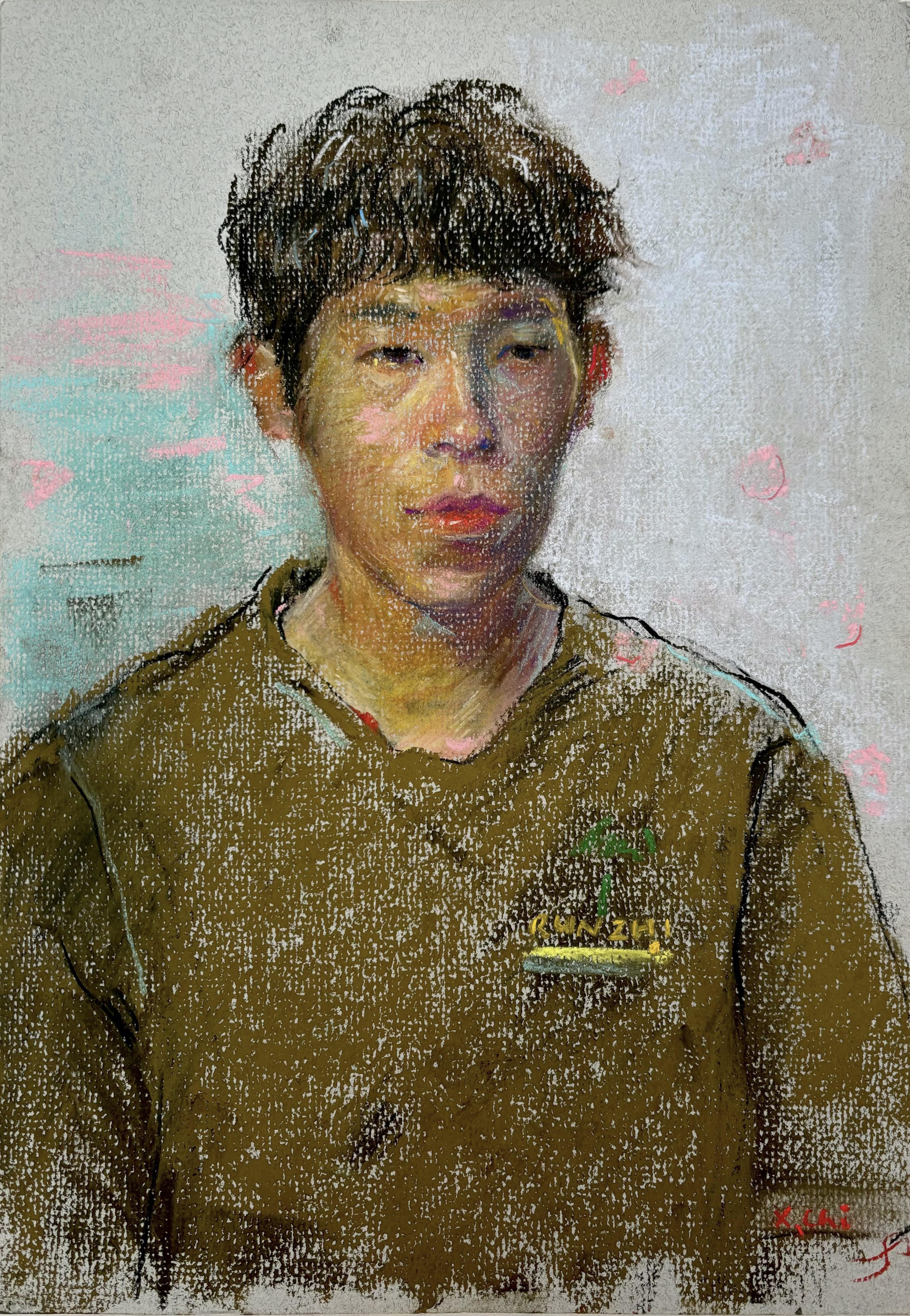
Shirley Chi
1. Could you please tell us about the artwork you are exhibiting at the Pastel Society Annual Exhibition 2026?
Practice Love
This work is a rapid sketch of my partner, created as an intuitive response to light, shadow, the surrounding environment, and the person in front of me within a limited timeframe. Rather than prioritising technical precision, I focused on capturing the emotions and colours evoked by the sitter in that moment. These immediate impressions, combined with my personal understanding of him, form the foundation of the work and shape its final expression.
Head Study
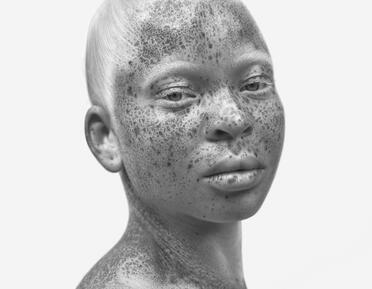
The “Head Study” is a study based on a photographic reference, created while I was preparing for the Portrait Artist of the Year 2025. I aim to practice portraying people of diverse ages and genders as extensively as possible.
What first caught my eye in this elderly man was the stark division of light: the right side of his face falls into deep shadow, while the left is brightly lit, yet the boundary between the two stays surprisingly gentle. Working with simple blocks of colour and a few decisive lines, I tried to reduce the forms to what matters most, and to suggest the wrinkles and hollows as simply as possible by using colour blocks.
2. How would you describe your practice as an artist?
My training has never followed a single direction. With a background in Visual Arts and Illustration, I enjoy experimenting with a wide range of media, including oil painting, clay sculpture, printmaking, and pastels, allowing each medium’s unique characteristics to interpret the narratives I construct.
Since beginning classical training at an atelier in London, I have worked primarily from life, developing a strong observational foundation. However, I see my practice as inherently multifaceted and resist limiting myself to a single form. Instead, I strive to cooperate all forms of art into my work.
My work explores the space between the real and the imaginary, integrating the immediate sensations and emotions evoked by the surrounding environment, people, and objects at the moment of creation. Storytelling is the salt in my art, whether it appears through a subtle colour mark, the sparkle of an eye, or through symbolic details - such as a letter or a feather - within a still life.
3. What draws you to working with dry media and pastels?
I used to work with oils a lot, until I was introduced to pastel, and fell in love with it immediately.
I‘ve always hoped that my painting style could be much looser, bolder, and more vibrant. Pastels have greatly helped me achieve this. I enjoy the decisive and spontaneous version of myself that emerges when I use them. It reveals a side of my personality that I don’t usually express. Unlike oil painting, where colours are mixed on the palette before being applied to the canvas, pastels allow me to mix colours directly on the paper, without considering too much about which is the right colour. Sometimes you can’t even get the exact colours of the objects, but the colour harmony, the intermittent lines, and the dots, create better results. I enjoy this process because it‘s not entirely controllable and often brings surprises.
4. How did you find out about the Pastel Society and what encouraged you to apply to their annual open call?
I’ve visited the Pastel Society’s exhibitions in previous years, and I also applied once before, after I began working with pastels. Seeing so many different approaches to pastel work is always incredibly inspiring for me, and it continually motivates me to push my own practice further. Being part of such a diverse and vibrant community is something I truly aspire to, and it drives me to keep making new work and continue trying.
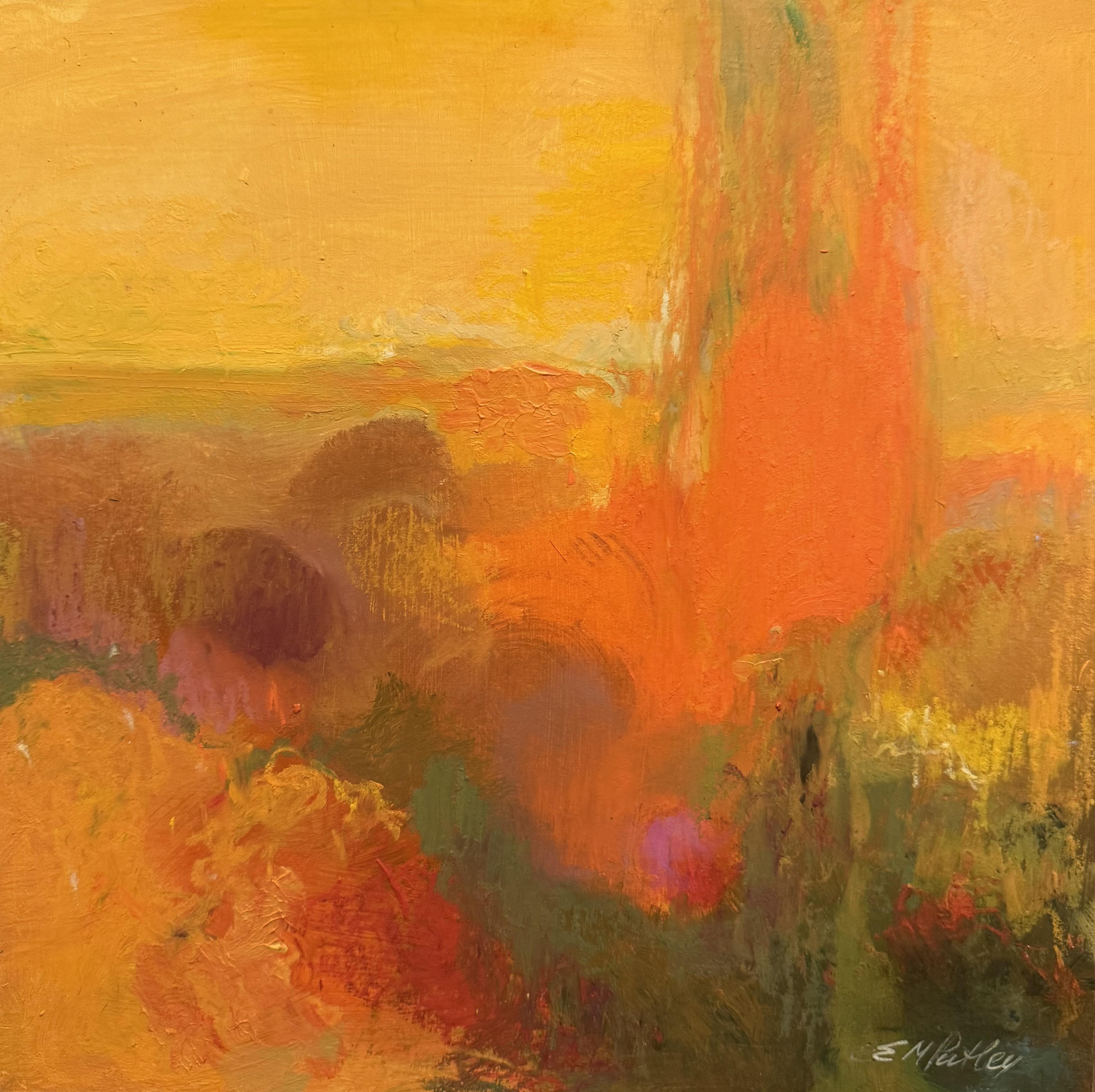
Elena Putley
1. Could you please tell us about the artwork you are exhibiting at the Pastel Society Annual Exhibition 2026?
Harlow Carr Gardens, Warm November, is part of a series of small pastel works. This piece was inspired by my visit to Harlow Carr Botanical Gardens last November, when the colours and unexpected combinations were particularly striking. The unusually warm weather felt unsettling for that time of year, subtly shaping the mood of the work. I used extra-soft oil pastel over a pre-painted acrylic background, allowing texture to emerge and rich layers to develop. The surface is sealed with a matt varnish and left unglazed, making the tactile qualities and marks clearly visible throughout.
2. How would you describe your practice as an artist?
My work investigates the tension between beauty and chaos in ever-changing landscapes, focusing on how weather, light, and air alter what we think we know. I create both large and small-scale pieces using oil bars, oil pastels, soft pastels, inks, and acrylics. I am interested in how places are experienced, remembered, and reimagined. Photographs, maps, and fragmented visual references merge with direct observation to create landscapes that are both familiar and unfamiliar. These hybrid environments reflect the way we now navigate the world: through screens, through travel, and through the imagination. Grids, traces, and repeated marks act as visual structures, while colour and texture evoke atmosphere and emotional resonance. Through these layered compositions, I aim to question what “landscape” means today, how it is constructed, how it is felt, and how it shapes our sense of connection, distance, and belonging.
3. What draws you to working with dry media and pastels?
I am an artist who is deeply invested in the process of making, rather than being overly concerned with the final outcome. What I love most about pastel drawing is its immediacy: the way my hand and the pastel stick seem to become one, functioning as a single, instinctive tool. I am particularly drawn to very soft oil pastels, as they invite a direct, physical engagement with the surface. Being able to blend the pigment with my hands, almost sculpting the image rather than simply drawing it, is an especially enjoyable and rewarding part of the process. There is a clear difference between holding a brush and holding a pastel stick. With pastel, the connection to the work feels more intimate, immediate, and tactile. This closeness creates a stronger sense of presence and responsiveness, allowing the drawing to evolve naturally through touch, gesture, and sensation as much as through conscious decision-making.
4. How did you find out about the Pastel Society and what encouraged you to apply for their annual open call?
I have followed the Pastel Society exhibitions at the Mall Galleries for many years and previously applied to take part in the annual exhibition, though my work was not selected. Every year, the exhibition presents a wonderful collection of drawings, offering a rich variety of concepts, ideas, and techniques. I have learned so much from these shows, and it feels truly special to now be part of this exhibition.
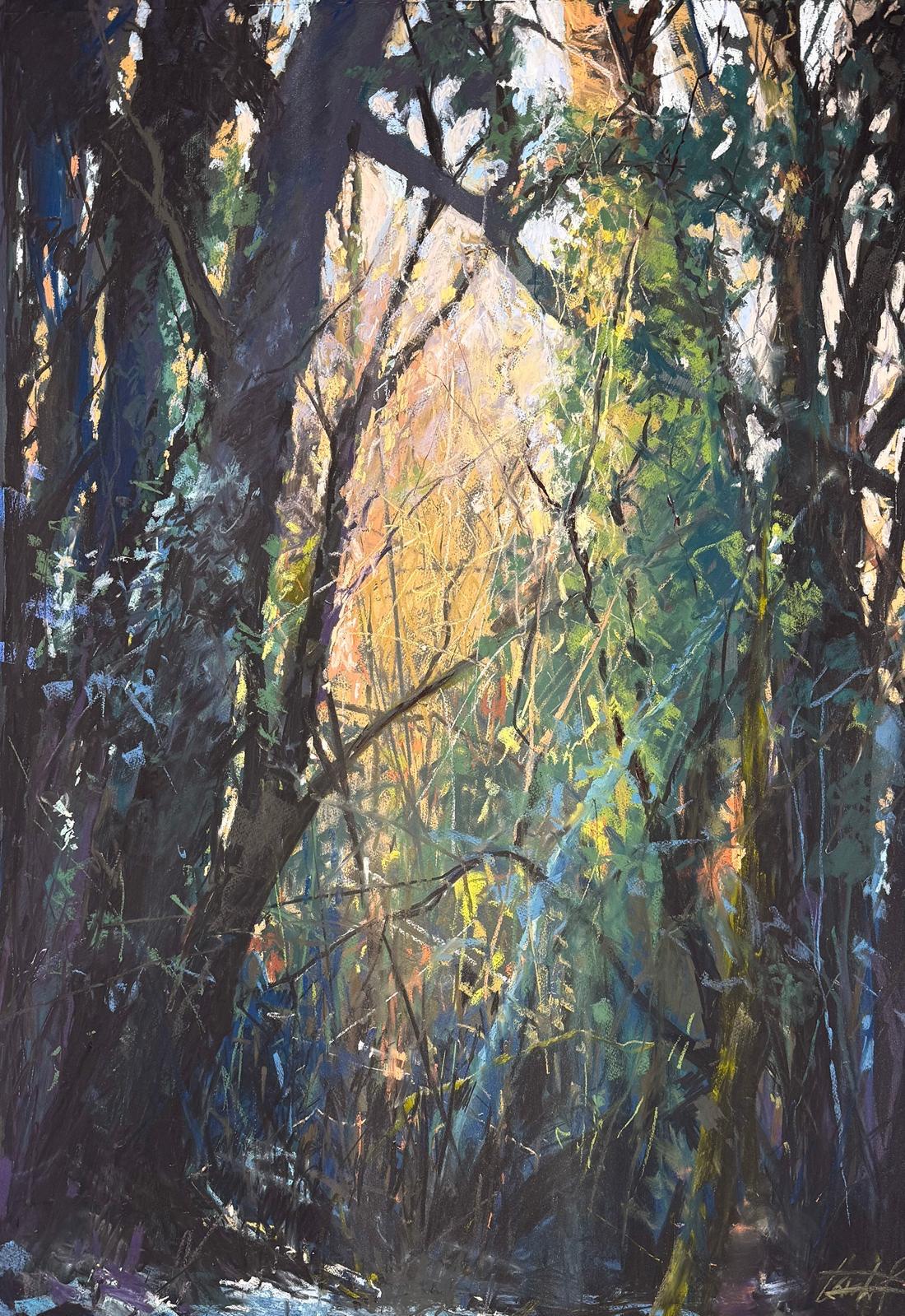
Trish Findlater
1. Could you please tell us about the artwork you are exhibiting at the Pastel Society Annual Exhibition 2026?
The Listening Trees is a large-scale pastel painting from a series of fifteen works completed in 2025, created in response to the effects of Storm Eowyn on my garden and the surrounding local woodlands. The piece is executed using extra-soft, highly pigmented pastels by U.S. manufacturer Terry Ludwig. Mounted and framed, the work measures approximately 120 x 90 cm. The viewer’s eye is drawn in from a dark, turbulent foreground of mangled, storm-damaged trees, rendered through expressive, gestural marks in deep purples, blues, greens, and earthy tones. This heavy foreground is set in contrast to the softer peachy yellows and pale blues of light breaking through the background. Together, these elements suggest a sense of hope, that the woodland may endure and regenerate beyond the destruction left by the storm.
2. How would you describe your practice as an artist?
Experiences of profound personal loss continually find their way into my work. My practice mainly centres on working en plein air in soft pastels and oils, exploring landscapes, seascapes, and interior spaces. Painting directly from life allows me to engage fully with the reality of colour and atmosphere, responding to my subjects with immediacy and honesty. This direct observation also fosters a depth of technical understanding that cannot be fully achieved through photographs or studio-based work alone.
This uncontrived approach encourages freer, more expressive mark-making, enabling me to capture fleeting moments, whether the vastness of a storm-laden seascape or the quiet intimacy of an interior. Within my landscapes and seascapes, storms and barren stretches reflect sorrow and loss, while moments of calm and the renewal of spring suggest hope, healing, and resilience.
3. What draws you to working with dry media and pastels?
When working outdoors, pastels allow me to respond quickly to fleeting changes in light and atmosphere, those brief moments when sunlight suddenly illuminates a woodland, pours through the rickety doorway of a small farm shed, or catches the crest of a wave in a flash of rainbow as it’s tossed by Atlantic winds along the West of Ireland’s shores. This immediacy is essential to my way of seeing and working.
Edges and contrasts between light and dark are central to my paintings, and I find square-edged pastels, such as Blue Earth, Terry Ludwig, and American Greats, particularly well-suited to this. They enable both precision and expressive mark-making, while also allowing me to build layers that suggest fog, mist, or the glare of strong sunlight. Pastels offer a sense of freedom and physical responsiveness that I find exhilarating. Although I also love the richness and unctuousness of oil paint, I feel less constrained when working with dry media, which encourages a more instinctive and fluid response to the landscape.
4. How did you find out about the Pastel Society and what encouraged you to apply to their annual open call?
I first became aware of the Pastel Society through my growing commitment to working seriously and professionally with pastel as a medium. I was immediately drawn to the Society’s strong professional ethos and its clear encouragement of excellence in pastel painting. The fact that it hosts an annual exhibition dedicated solely to this medium reflects a genuine respect for pastel artists and fosters a strong sense of artistic community, something I value greatly.
I paint both in Ireland and abroad with a wonderful community of plein air artists and often alongside highly accomplished professional artists such as Jenny Aitken, Haidee-Jo Summers, and American artist Aaron Schuerr, who have consistently encouraged me to exhibit my work. When I saw that the Pastel Society’s annual exhibition was open to submissions, it felt like a natural and timely opportunity to apply and to place my work within a wider professional context.
I will admit that the courier process has been slightly nerve-wracking with the particularly long journey of transporting a delicate pastel painting from Ireland, with no guarantee that it will arrive at the gallery in pristine condition. Nonetheless, the opportunity to be considered by such a respected organisation made the risk entirely worthwhile.
Holly Milligan
1. Could you please tell us about the artwork you are exhibiting at the Pastel Society Annual Exhibition 2026?
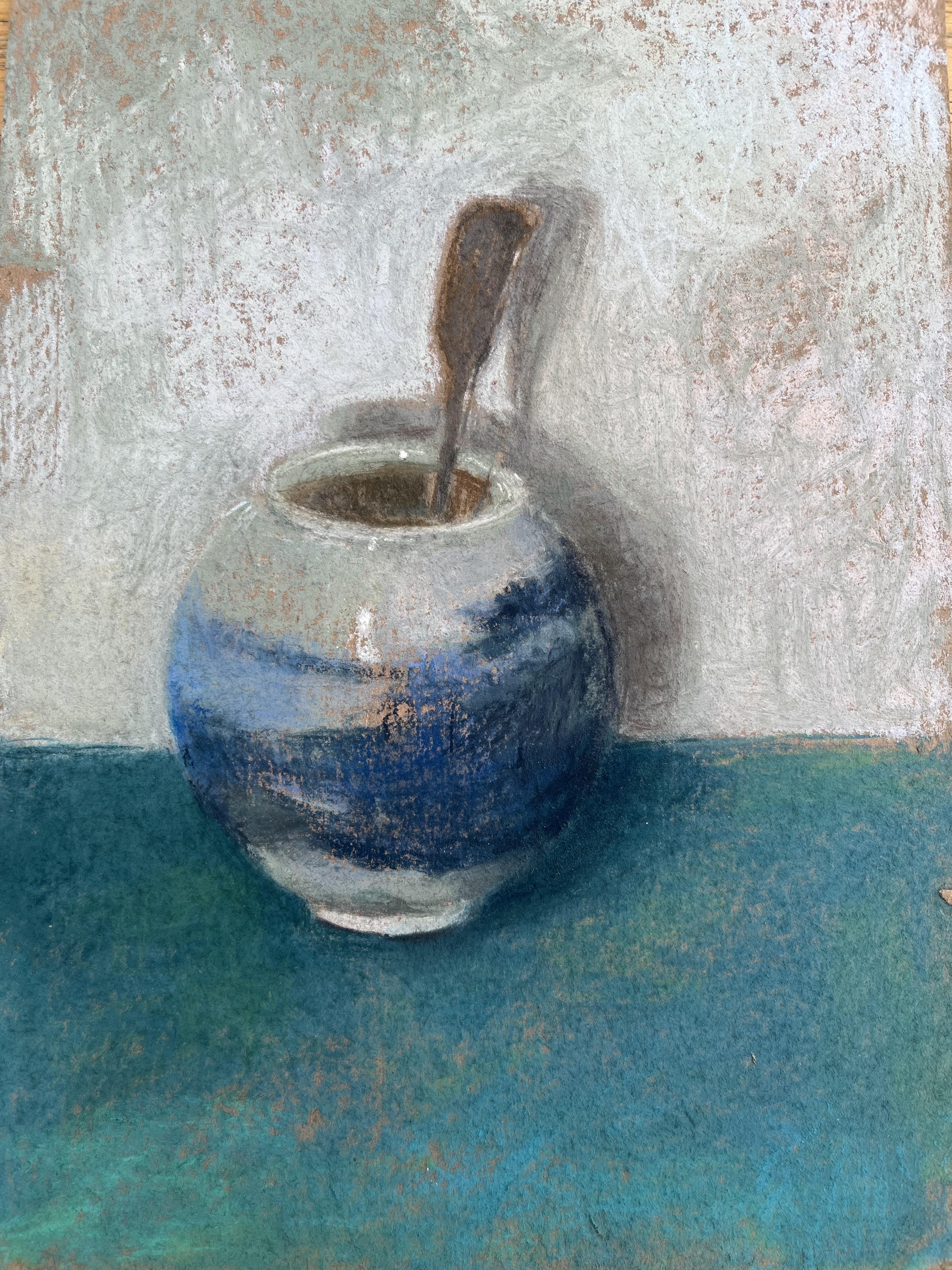
Ginger Jar is one of a series of still lifes that I drew over the summer of 2025. I began looking at the French artist Jean-Simeon Chardin and how he set up his still lifes, always with a point of interest: a knife or spoon set at an angle to draw the viewer in. It intrigued me and led me to draw the ginger jar with a spoon.
2. How would you describe your practice as an artist?
I am mainly a still life painter, in pastels and oils. I enjoy the theatre of setting up objects, working out the best light for dramatic or subtle shadows, discovering the brilliance of colour combinations and finding the simplest way to convey this to the viewer.
3. What draws you to working with dry media and pastels?
I have always worked with chalk pastels, they are such a forgiving and immediate medium. Pastels give you the ability to carve out, almost sculpt a painting, layering up colour and taking it away. The range of colour is endless!
4. How did you find out about the Pastel Society and what encouraged you to apply to their annual open call?
I found the Pastel Society from browsing on the Mall Galleries website, and I just thought I would give it a go: the application process was very straightforward and I am delighted to be exhibiting in the Pastel Society’s Annual Exhibition.
Nicholas Nunn
1. Could you please tell us about the artwork you are exhibiting at the Pastel Society Annual Exhibition 2026?
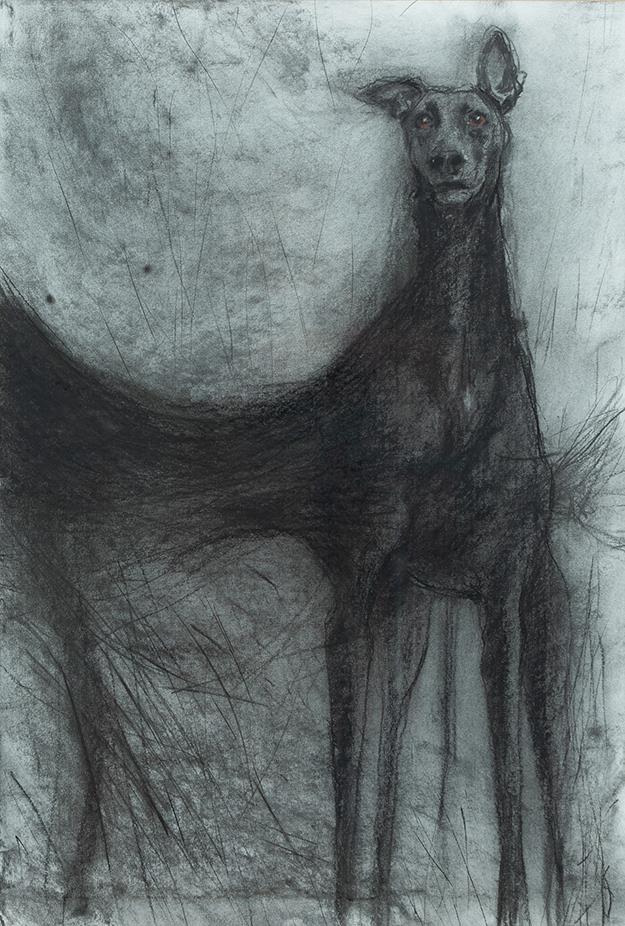
I am exhibiting Windhund, a charcoal and pastel drawing of a greyhound set in a back field in tempestuous weather and fading evening light.
I, in some part, wanted to convey the need to focus, brace oneself and turn towards seriousness when enduring such weather. Conversely, I liked the idea that the greyhound was excited and absorbent of these conditions and would enjoy chasing the wind around. Windhund is the German for greyhound.
2. How would you describe your practice as an artist?
My practice at the moment involves mainly drawing and the use of rapid and expressive mark making, I am enjoying working really fast initially and then slowing down and being more considered.
3. What draws you to working with dry media and pastels?
Dry media and pastels, for me, lend themselves to the fast tempo I like to work at currently. I enjoy the medium's directness and also the randomness that a less sharp and precise drawing point offers.
4. How did you find out about the Pastel Society and what encouraged you to apply to their annual open call?
I found out about the Pastel Society when a friend took me to last year's exhibition, it was very inspiring and we also watched Curtis Holder give a brilliant demonstration. I never dreamt I’d be fortunate enough to be exhibiting in it myself the following year!
Pastel Society Annual Exhibition 2026
All of the works featured in this interview are available to buy and browse online, alongside the rest of the works selected for the Pastel Society Annual Exhibition 2026.