
Interview: First-Time Exhibitors at the RSMA Annual Exhibition 2026
/ Royal Society of Marine Artists
The RSMA Annual Exhibition features a vast range of work by various artists - members and non-members alike - all interested in celebrating the sea. The common theme is the sea and tidal waters although, within that remit, work is wide and varied.
Here, we speak with three first-time exhibitors with the Society ahead of the RSMA Annual Exhibition 2026 at Mall Galleries.
Introducing Jasmina Ajzenkol, Ann North, and Oliver White...
Jasmina Ajzenkol
Please tell us about the artwork you are exhibiting at the RSMA Annual Exhibition.
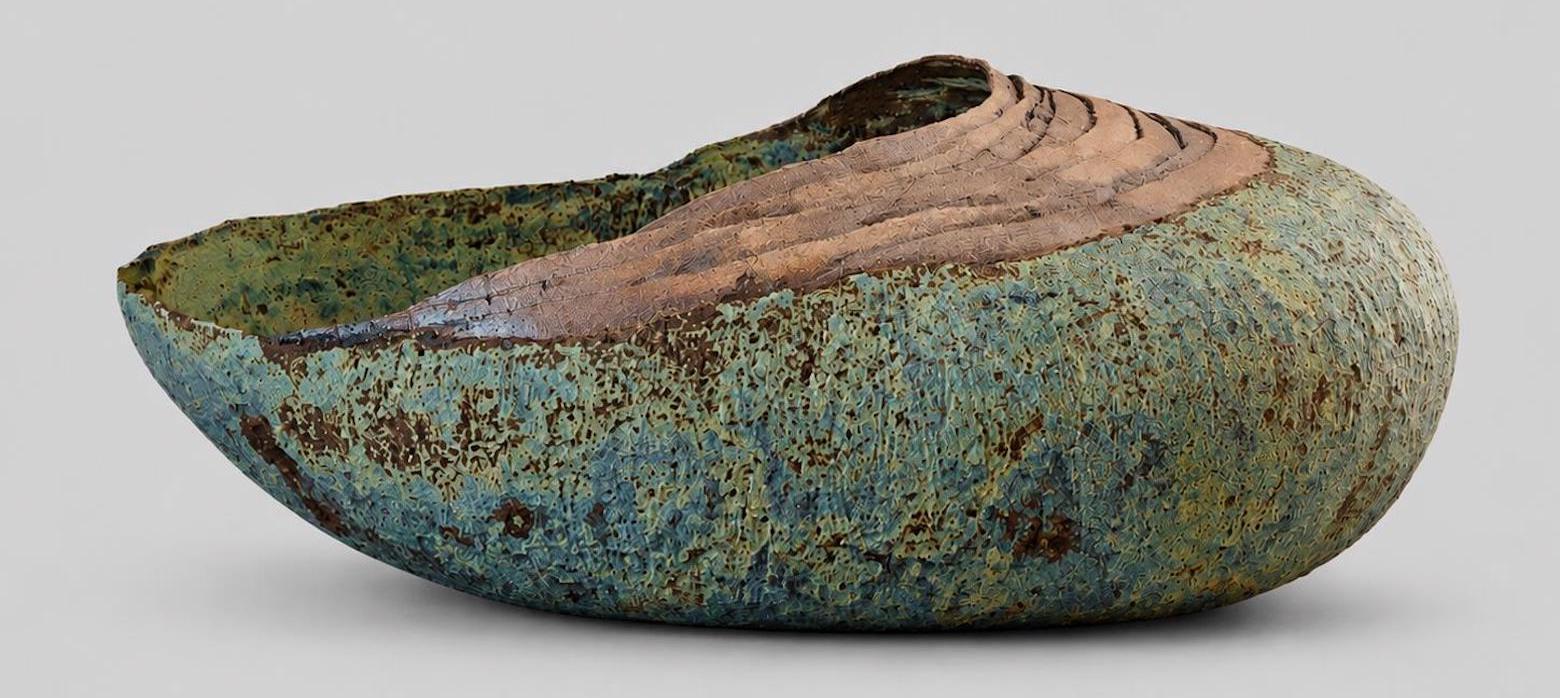
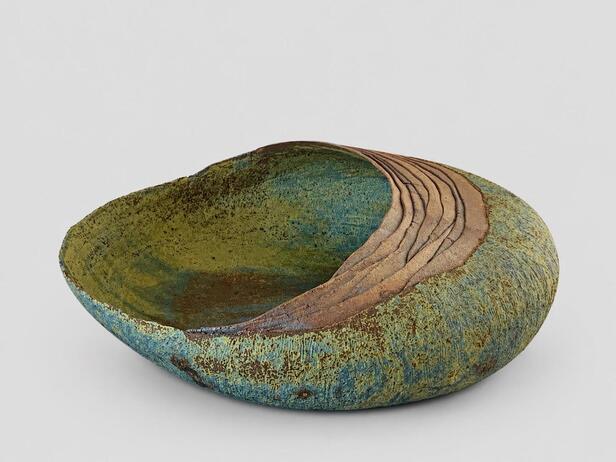
The piece I am exhibiting comes from my Marine Collection, a body of work directly inspired by the sea and shoreline. It's a hand-built vessel with a generous, open form, its rim curling inward like a shell washed up on the tideline. The surface moves between deep blues, mossy greens and earthy ochres, echoing the colours you find where sand meets rockpool meets seaweed. One edge carries a rippled, ridged texture, reminiscent of ribbed sand left by the retreating tide, while the rest of the body is softly mottled, as if it has been worn by years of water and weather. I want the piece to feel as though it has always belonged by the sea, not simply as a representation of it, but as an object that could have been shaped by the same forces that shape a coastline.
How would you describe your practice as an artist?
I work slowly and instinctively, building every piece by hand using a coiling technique rather than a wheel. This lets me create forms that feel organic, flowing and slightly irregular, closer to something grown or found than manufactured. Once a piece is bisque fired, I spend time developing its surface, building up oxides and dry glaze in layers to create depth and colour variation across the form, where blues and greens shift gradually into warm bronze ridges. It's a process with a lot of unpredictability, especially at the glaze-firing stage, and I've come to enjoy that. Each piece surprises me slightly, and that keeps the practice feeling alive after twenty-five years.
What draws you to working with ceramics?
Clay responds immediately to touch, and I find that tactility addictive. What keeps me working with it, though, is how well it lets me translate the natural world, particularly coastlines, into three dimensional forms. The vessel in the photograph draws on the form of a shell, while its surface takes its rhythm from the bands of sand, gravel and weed sorted by the tide along a beach. Ceramics lets me combine both of those inspirations in a single object; a shape borrowed from nature, and a surface that carries the memory of weather, water and time. I don't think any other material would let me bring those two things together in quite the same way.
How did you find out about the Royal Society of Marine Artists and what encouraged you to apply to their annual open call?
My work has always drawn heavily on the sea, from shells and underwater creatures to the textures left behind by the tide, so the RSMA felt like a natural fit once I came across it. I split my time between Birmingham in the UK and a village on the Istrian coast in Croatia, and the sea is a constant presence and source of inspiration in both places. Having exhibited with the RBSA and other UK shows for over two decades, I was keen to put my work in front of a society and audience specifically devoted to marine subjects, and to see how a piece rooted in ceramics sits alongside paintings, drawings and sculptures that share the same source of inspiration.
Ann North
“As an emerging artist, who started drawing 18 months ago, one of my goals was to get an exhibit in a city gallery.”
Please tell us about the artwork you are exhibiting at the RSMA Annual Exhibition.
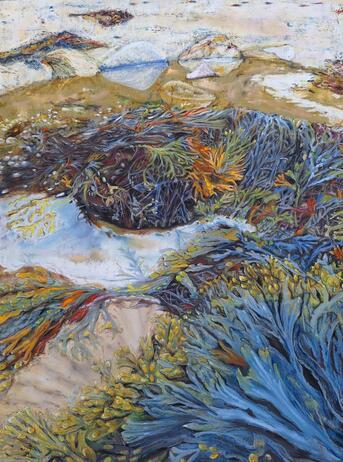
‘Pools of Bladderwrack’ is in pastels on Clairefontaine Pastelmat.
I was attracted predominantly by the colours of the seaweed, in August, near Robin Hoods Bay, North Yorkshire. The naturally occurring vibrant oranges and reds against the blues and greens were extraordinary. The way the receding tide had transmitted the movement to the resting seaweed, displaying it in a directional arrangement on the sand and rocks, with the dentritic fronds splayed out against each other, competing for nutrients. This is also repeated in the patterns of sand, providing a natural movement to the whole image. A cloudy sky reflecting in the rockpools in the middleground, with the low tide sands in the background, provides contrast overall.
I started with Faber Castell hard pastels and used Sennelier soft pastels for the very vibrant highlights.
How would you describe your practice as an artist?
As an emerging artist, it is such a pleasure to learn and discover drawing and painting. I work in acrylics, pastels, charcoal, graphite and coloured pencils.
I take inspiration from colours, light, shapes and patterns around me, in nature and daily life, subjects that hold a personal connection, sometimes fleetingly. I research techniques, drawing inspiration especially from Impressionists and contemporary artists.
I use photography for outdoor images, as this suits my current lifestyle, and use that as a learning tool for composition and analysis. My work is built up gradually depending on my pockets of available time.
What draws you to working with pastels?
The main attraction to working with pastels has to be the pigments - how can you resist a box of pastels! They produce such vibrancy and in this particular painting, pastels were the obvious medium.
The convenience and immediacy allow me to paint at any time without the time pressure of mixing or drying of paint, or cleaning of palettes. I can stop and start whenever I want.
How did you find out about the Royal Society of Marine Artists and what encouraged you to apply to their annual open call?
A year ago, I was recommended to visit the Mall Galleries as a welcoming, bright space with contemporary figurative art that I like. I was not disappointed. It also has a great little cafe. I really liked this gallery! I signed up to the Mall Galleries official website, and discovered the Open Calls.
As an emerging artist, who started drawing 18 months ago, one of my goals was to get an exhibit in a city gallery. Having lived most of my life by the sea, and studied the sea and shores for years, the Royal Society of Marine Artists Annual Open Call was an obvious choice and the application process was straightforward.
This is my first time exhibiting a painting anywhere, and I am honoured to have been selected to exhibit in this show at such a prestigious gallery.
Oliver White
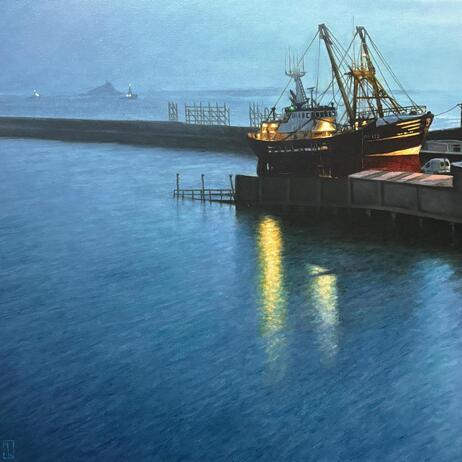
Please tell us about the artwork you are exhibiting at the RSMA Annual Exhibition.
My two submitted works depict the beam trawlers Cornishman and the Trevessa IV – in Newlyn harbour. Both paintings show the harbour at first light, and on a high tide.
This harbour has always been special to me; its history, its community and how it offers a refuge from the Atlantic Ocean beyond its walls all draw me both professionally and personally. I see these vessels landing their catch, being repaired or simply resting alongside before, once again, taking their crew out to the grounds that have been fished for generations. Here, in the harbour, they seem so huge, almost intimidating in themselves, but when you see them from the cliffs of West Cornwall, heading out to sea, the scale and danger of their task is clear.
How would you describe your practice as an artist?
My working practice begins with drawing. I have drawn all my life, mostly figuratively; but I also use compositional devices found in more abstract painting. I am constantly making discoveries about the media I use. I will have, with each piece, an idea of what I want to focus on – such as surface quality, an effect of light or the movement of water – and through trial and error, research and happy accident, I move towards what I want to achieve, learning along the way.
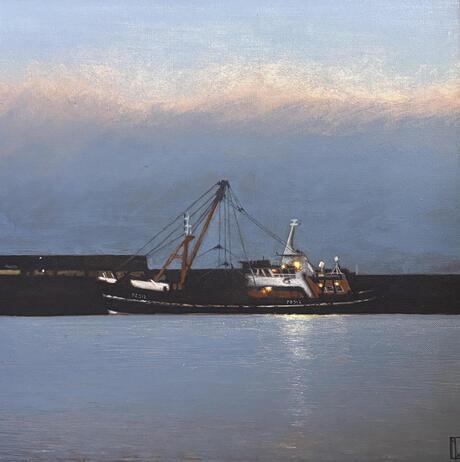
What draws you to working with oil paint?
I enjoy the slowness of using oils and how it’s a medium that rewards patience and persistence. I tend to work using multiple glazes of transparent colour, and the power of certain pigments, even when used in these thin glazes, is astounding to me.
Oil painting has such a huge historical footprint on our pictorial and artistic culture and I am reminded, when using it – with the smell of linseed oil and a new tube of paint – of the centuries of painters who have used it before, not least those artists of the Newlyn School themselves.
How did you find out about the Royal Society of Marine Artists and what encouraged you to apply to their annual open call?
I have known of the Mall Galleries and RSMA for some time and am aware of the high standard of painting that its annual exhibition attracts. I was keen to exhibit alongside painters who I deeply admire, and having focussed a lot of my work on Newlyn harbour for the past two years, I felt this was the ideal time to submit. I am so pleased to have both of my submitted pieces included this year and showing at the Mall Galleries feels an exciting next step in my path as a painter.
Browse & Buy Marine Art
Discover and buy works by Jasmina, Ann and Oliver, plus more marine art, at the RSMA Annual Exhibition 2026.
Image credits
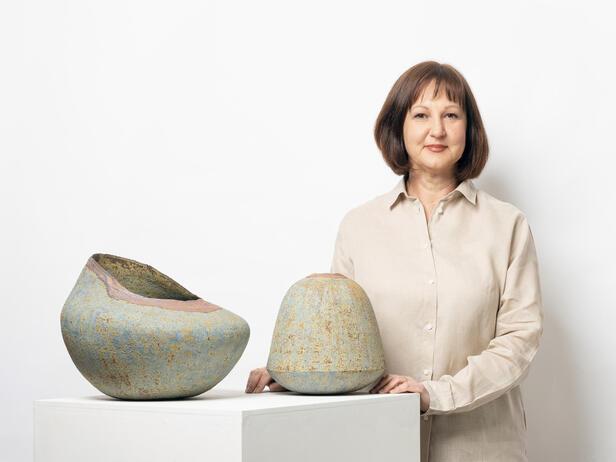
Jasmina Ajzenkol in her studio
Jasmina Ajzenkol, Marine Collection 242, Ceramics, 13x36x36cm (featured as banner)
Ann North, Pools of Bladderwrack, Pastel on paper, 40x30cm
Oliver White, Trevessa IV on Newlyn Slip, Oil on canvas panel, 40x40cm
Oliver White, PZ512 'Cornishman' Newlyn North Pier, Oil on canvas panel, 30x30cm