Royal Institute of Painters in Water Colours 2026 | In the Artist's Words
/ Royal Institute of Painters in Water Colours
In the Artist's Words
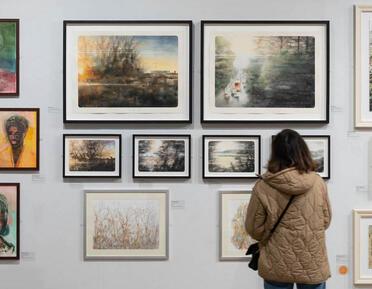
The Royal Institute of Painters in Water Colours presents the RI 214th Exhibition from 25 March to 11 April 2026 at Mall Galleries.
Here, exhibiting artists offer insights into their works in their own words:
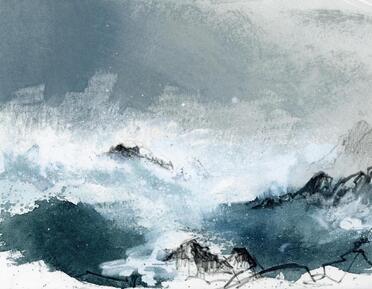
90mph gusts blast off the sea, ripping seafoam from waves, lashing rain into my eyes and driving the storm to a crescendo. It’s wild. The sheer power of the weather is spectacular to experience. It knocks me to my knees as I scrabble along the shore. The water is churning, the calm turquoise of the Hebridean waves replaced with muted yellow and thunderous blues. Every glance into the wind is blurred with the sting of salt and driving rain. It’s impossible to stand for more than a staggered step. I wedge myself against a rock in a futile attempt to make marks. The paper becomes sodden and wind ripped. The Storm Floris Series were painted during a spectacular weather event that hit the Outer Hebrides in August 2025. I was out there on residence at Borvemor Arts and worked almost entirely plein air over the course of the summer, including in the storms. Our changing weather systems fascinate me. Feeling wave and weather physically impact my markmaking is integral to my way of working.
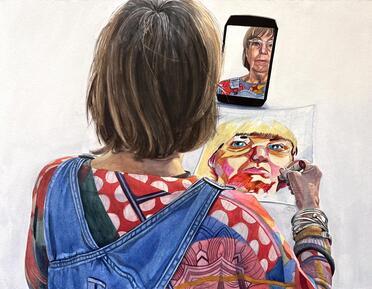
Julia Karl
Portrait of Artist Alison Chaplin
Watercolour, gouache and watercolour pencil on board, 38x51cm
This portrait depicts the artist Alison Chaplin working on her own self-portrait while observing herself in a mirror. For her self-portrait, she is using oil pastels. To emulate both the texture and the process of applying, smoothing, and blending colour with a medium, watercolour pencils were used.
Gary Cook VPRI
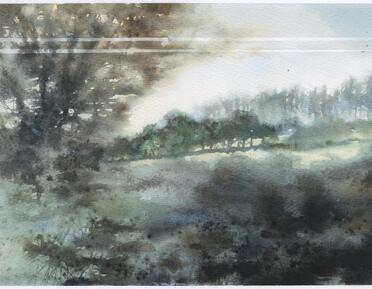
Train Trees. Passing Devizes
Ink, watercolour and charcoal on board, 22x32cm
The 09.09 from Westbury to Paddington. I love the hypnotic blur of trees while looking out the window of a speeding train. We all know that railways are environmentally one of the best ways to travel, but the corridors of trees and vegetation that line the tracks are also doing their bit. Because humans rarely visit them, all sorts of wildlife use these green links to live in and move around. In the UK, if the 130,000 acre trackside network of embankments and cuttings were condensed together it would be one and half times the size of the Isle of Wight. That's a lot of undisturbed biodiversity. Species dependent on these habitats are silhouetted in the painting.
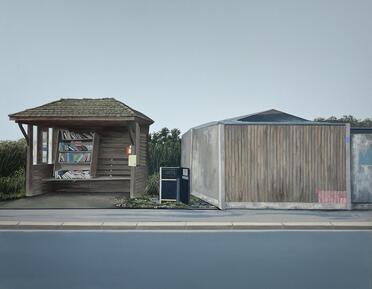
Nostalgia. The bus stop, the portal to every great adventure and drunken, drug fuelled mishap when I was a teenager. The start and end to a journey, yet now as an adult these spaces pass me by. Whilst painting this quaint symbol of community, somewhat lost in the landscape, I couldn't help but think of all the insane things that happened centred around buses and bus stops as a teenager. These were our vessels, voyaging through volatile concrete seas, an important part of connecting with friends and in some cases enemies. The graffiti crews I hung out with, the punks, the rude boys, my friends, we all have a story to tell. Travel causes us to reflect, to think about the past, a somewhat unhealthy place to live, I look forward.
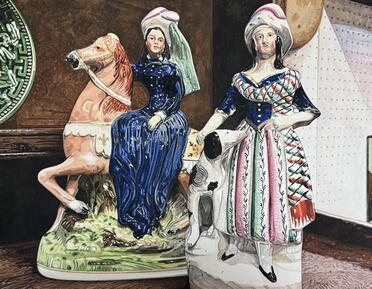
The Empress Eugénie of France (1826-1920) on horseback accompanied by a loyal attendant. Eugénie is credited as bringing haute couture to the world. Whilst this painting was being completed in October 2025 the news broke of a theft of jewellery from The Louvre including a crown which once belonged to the Empress. In the 19th century earthenware figurines representing popular and significant members of royalty were produced in the pottery factories of Staffordshire. Mark Elsmore RI has celebrated the history and artistry of his home county.
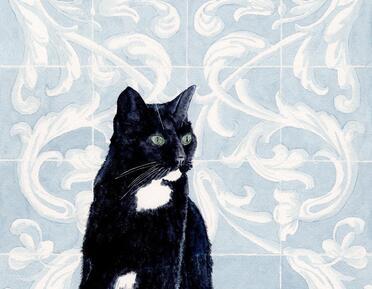
This painting of my cat is part of a cohesive group of six watercolour paintings created specifically for the RI 214th Exhibition. The works are unified by the recurring use of Portuguese tile patterns and by a shared composition, informed by Renaissance portraiture, particularly works such as 'An Old Man and An Old Woman' by Quinten Massys, Albrecht Dürer’s 'Portrait of a Young Woman (Katharina Fürleger)' and Domenico Ghirlandaio’s 'Portrait of a Lady'. In each of these works, the sitters rest one or both hands on a narrow, flat surface at the lower edge of the picture plane, a compositional device I have adopted to establish spatial clarity and compositional balance. The consistent use of headwear further reinforces structure across the series and a sense of formality. I have also allowed space for humour within the series, again drawing on Renaissance precedents, through the inclusion of a laughing figure and this portrait of my cat sitting on the same flat surface.
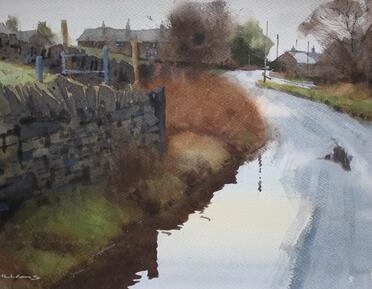
It's all about the puddle. And when it went on social media, hundreds of people said the same thing. That puddle! In 'Sombre Reflections of a Wet Day' I tried to lift the mood with the reflective light in the water and it turned out to be the star of the show.
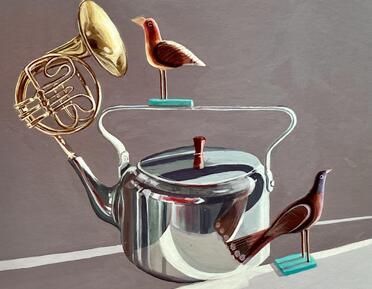
A still life composition where I've enjoyed using ink to depict hard, reflective surfaces, with a little note of surrealism. I saw the Wayne Thiebaud exhibition before Christmas and wanted to simplify my composition by using a painted line to suggest a flat surface. What you can get the brain to accept is fascinating and something I want to explore further.
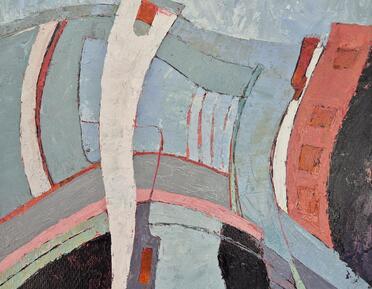
'City Life' is about the interaction between the River Thames and the city it flows through. There is a suggestion of bridges connecting the high rise buildings that look down on the water.
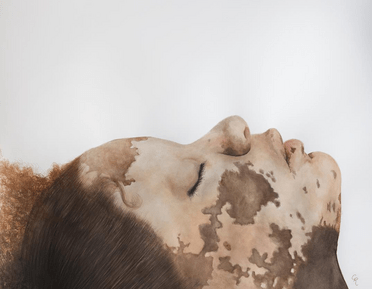
My work showcases that every face carries a narrative worth seeing, valuing, and understanding. Through hyperrealistic portraiture, I explore the human face not only as a likeness, but as a vessel for identity, emotion, and social perception. Living with vitiligo, I use my experience of visible difference to examine how beauty standards are constructed and challenged. I aim to show that uniqueness is not something to hide, but a source of strength and beauty. By portraying subjects who defy conventional expectations, I celebrate individuality and confront stigma. My portraits are personal and political: they invite viewers to look closer, question assumptions, and recognise the depth, dignity, and complexity within every face. Working primarily in watercolour, I highlight subtle textures, tonal shifts, and emotional layers. Rather than idealising, I seek truth - capturing overlooked details that reveal character and humanity, and promote a more inclusive understanding of beauty.
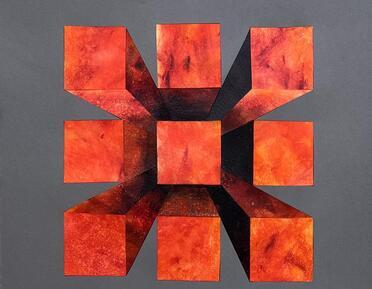
'Quboid' explores cubic illusion through my paper inlay technique, where nine vibrant squares appear as rhombohedra of immeasurable length converging at a distant horizon. Each square has been painted with acrylics to create subtle tonal and textural variations, then hand-cut and precisely positioned to suggest impossible spatial relationships. The cool grey background acts as neutral space, allowing the warm tones and deep shadows to create maximum contrast and dimensional depth. This symmetrical arrangement has a mandala-like quality, yet its geometry remains deliberately ambiguous. The eye searches for a stable reading—is this a cubic form viewed from above, a star pushing outward, or a lattice folding in on itself? The paper inlay technique transforms flat materials into sculptural paradox, where shadow and placement suggest three-dimensional forms that logically cannot exist.
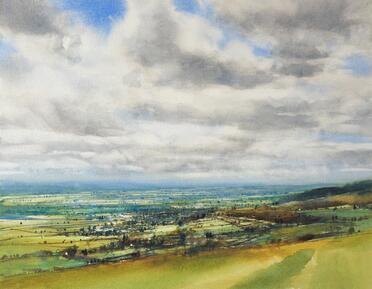
A distant view from the Mendip Hills over the Somerset moors and wetlands. ‘Before the Green’ is from a series of walks in February, trying to capture the last breath of Winter before everything starts to turn green.
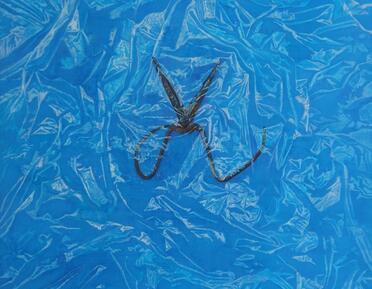
This watercolour presents a pair of scissors placed beneath a sheet of blue plastic, observed with close attention to surface, light, and material behaviour. Layered washes and tonal modulation describe the translucent plastic, whose folds and reflections create a visual field reminiscent of water, subtly destabilising the object's spatial position. The scissors are rendered with clarity and restraint. Although recognisable as a functional tool associated with cutting and precision, their purpose is suspended by the thin barrier that covers them. The contrast between the hard, defined form of the metal and the soft, irregular plastic introduces a quiet tension within the composition. The restricted blue palette unifies the image while removing it from a specific setting, allowing the still life to operate as a study of containment and delayed action. Through careful observation and controlled technique, the work reveals latent unease in an object whose function is interrupted.
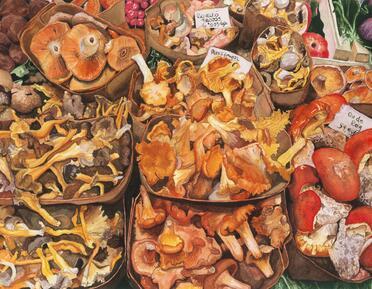
'Ou de Reig' is part of a series that investigates the human quality of markets. The marketplace acts a reminder of how we have traditionally interacted, consumed mindfully, and placed importance on sensory experiences. It is a space that still demands physical attendance in a world that is increasingly isolated by technology. A still life of carefully displayed items is created by a roaming gaze, acting as a memento mori. The fluidity of watercolour evokes the transient experience of physical presence, observation, and memory.
Explore the Exhibition
The Royal Institute of Painters in Water Colours presents the RI 214th Exhibition, the largest exhibition of its kind, featuring over 400 of the finest contemporary watercolour and water-based media paintings from around the world.