Interview: First-Time Exhibitors at The Natural Eye 2026
/ Society of Wildlife Artists
The Society of Wildlife Artists presents The Natural Eye, an annual exhibition of fine art inspired by the natural world.
Showing work by Society members alongside artists selected from an open call, this exhibition presents a wide-ranging collection of work that celebrates the natural world.
Here, we speak with three first-time exhibitors with the Society ahead of The Natural Eye 2026.
Amanda Bradbury
Please tell us about the artwork you are exhibiting at The Natural Eye 2026.
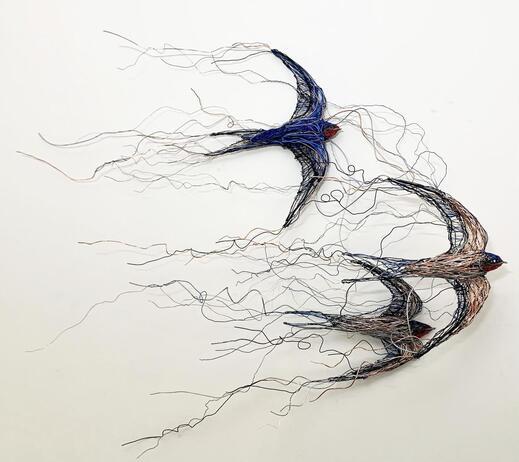
My sculpture was inspired by the Swallows circling over our house and garden this summer. I wanted to emphasise the air turbulence and sense of movement generated as the Swallows swoop and swerve, seemingly effortlessly around each other as they catch insects on the wing. The structural element of the sculpture is made from a mix of iron-binding wire and gardening wire that is interwoven with up-cycled, stripped computer wires and power cable.
How would you describe your practice as an artist?
I have been drawing, painting and sculpting all my life. From an early age I was fascinated by how nature worked. I would fill sketchbooks with life studies of animals and plants to understand more. This fascination and drive to discover the natural world led me to gain a degree in biological sciences and later an HND in technical Illustration. With a career bridging ecology, nature conservation and illustration, I have learnt not only the importance of detail and accuracy but also capturing the essence of my subject.
As a passionate nature conservationist I strive to reduce my own impact on the environment. I do this in my art by up-cycling and repurposing materials that otherwise would have ended up in landfill.
What draws you to working with wire?
I love the ‘scribbly effect’ and the projected shadows it creates. You can achieve great things with just a pair of pliers and wire cutters. When I start a project the wire is chaotic, unruly and challenging to work with, but eventually it reaches a state of stability and no longer tries to spring out of control. The form emerges and it’s a great feeling. No sculpture starts the same way or ends the same way as I’m always experimenting with techniques and learning something new.
There’s a surprising wide range of coloured wires that allow me to build up tones and patterns without the need for paints. If a cable has been stripped out of a wall in a house project I often don’t clean off the paint as it adds character and acknowledges that the materials have a story to tell too.
How did you find out about the Society of Wildlife Artists and what encouraged you to apply to their annual open exhibition?
I have known about the SWLA, and how prestigious it is in wildlife art, right from when I was a student studying Natural History Illustration in 1998 at the Arts University, Bournemouth (then Bournemouth & Poole Art College). I always loved visiting the exhibitions over the years, it’s great to see such a wealth of talent and approaches in celebrating the beauty of nature. I know a few fellow ex-students and artists that have exhibited or are currently exhibiting at this exhibition so I’m so pleased to be part of this talented community this year.
Brent Bauer
Please tell us about the artwork you are exhibiting at The Natural Eye 2026.
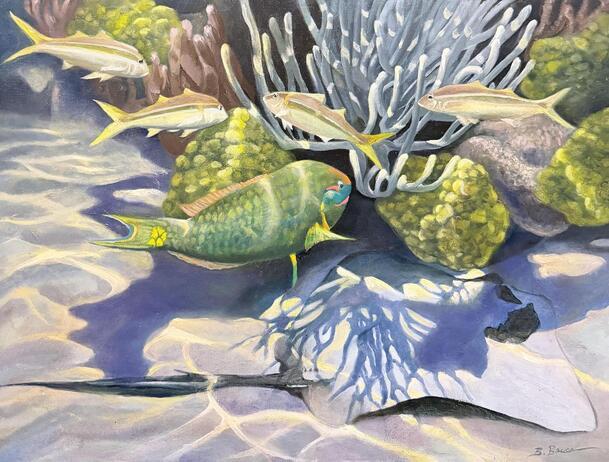
‘South Channel garden’ is a moment in time observed, captured on canvas, a spectacular dance of light and life.
South Channel is one of a few breaks in the barrier reef which protects the shores of East End, Grand Cayman Island, and allows for the ebb and flow of tides and nutrient rich water. The South Channel garden lies about 20 metres to the west and 2 metres deep at this intersection.
How would you describe your practice as an artist?
The combination of fine arts and accurate biological illustration has influenced my current paintings. Paintings of underwater environments and the ocean wildlife found there can be prone to fantasy and combinations which may not be truly accurate. I believe an artist studies and paints what they know and are passionate about. Over many years of travel and diving the oceans, I have always had a sketchbook and camera by my side and my thousands of personal photos support my memory and details of the fleeting undersea world. I endeavour to capture the essence of my paintings with accuracy and push the limits of storytelling without sacrificing validity.
My roots as an artist are anchored in traditional media such as oil, watercolour, acrylic, and mixed media. My medium of choice is oil on canvas or board, with layers of glazing. The feel of a brush and oil on canvas is a spiritual experience, a time when infinite possibilities exist.
What draws you to depicting wildlife?
Like a good novel or a song, each animal has its own story. While every subject of a painting is really about an individual artist's filter and interpretation, from realism to abstraction, the possibilities are infinite. When I am in the painting, I am for a moment part of the painting, and in that understanding, part of the animal.
I choose to depict wildlife through my own filter, and present it to the world, much like a zoo in which there are no walls, no harm to the animals, and I am able to raise awareness of unseen or seldom seen creatures and habitats. I can use depictions of the wildlife I choose to create a body of work for causes which could in turn possibly change the course of the animal's destiny.
How did you find out about the Society of Wildlife Artists and what encouraged you to apply to their annual open exhibition?
I have for many years had exhibitions and shows of my wildlife art in the United States and Caribbean. I have also been involved in associations of artists which I have found to be beneficial and a great learning experience. In the past year I have relocated to live and continue my art in Hsinchu City, Taiwan. New horizons, and new markets.
In my search for new horizons I encountered the Society of Wildlife Artists through Instagram. The call for entries to this year's exhibition was a beacon to one such new horizon.
Reece Ingram
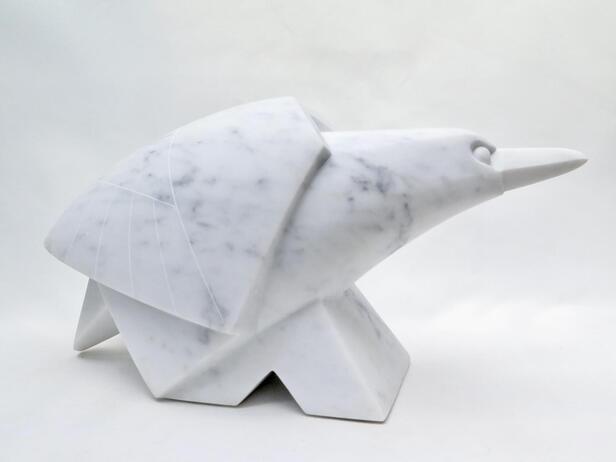
Please tell us about the artwork you are exhibiting at The Natural Eye 2026.
‘The night watchman’ is a representation of a Night Heron, something I saw when paddling through The Marais in Southern Brittany. Although apparently shy, they didn’t fly away even though we were very close. They watched me as intently as I watched them.
I see them as an assemblage of parts which have an infinite potential for construction and play: beak, wings, tail, body and neck. The sharpness of the beak and wing tips provide a potential for movement, they puncture space. Of course, there is the problem of legs, long thin ones. The answer for me is to see them as purely sculptural forms, spaces and movements which support and project the body. They do something else other than represent legs.
How would you describe your practice as an artist?
It all started with taxidermy and I did train for one year but I wasn’t that good. I discovered sculpture on my Foundation Course and I realised it gave me more freedom to represent what I saw and felt.
I divide my time between ceramics and stone carving. One feeds the other. Ceramics are relatively quick to do and I can work through a series of ideas, my mind is on the move. Carving and the reductive process is slower, once it has gone it cannot be put back. However, it can be manipulated plastically (to quote my MA lecturer, Lee Granjean). It is more fluid than one would expect. Subsequent movements are a consequence of previous ones.
I’d like to think I am part of a lineage of sculptors. What I do is an interpretation of what I have seen and experienced over many years. It’s what makes my sculpture mine.
What draws you to working with Carrara marble?
Carrara marble is an iconic stone - apparently the ultimate sculptor's stone for its purity, fine grain and translucence. It has been worked for thousands of years, a history which I am now a part of myself.
I bought about 1 ton directly from Studio Sem in Carrara (I couldn’t afford Staturario, this is Ordinario). The whole process was extremely exciting, waiting for it to arrive on a pallet from hundreds of miles away to me in Cornwall.
How did you find out about the Society of Wildlife Artists and what encouraged you to apply to their annual open exhibition?
I have been following other artists on Facebook and Instagram and they are members or have shown with SWLA. I have been aware of the SWLA for some time though. I loved the idea of being a part of this. I didn’t know if my work would fit. Applying for a show like this involves being judged. Am I good enough? Will I be found out?
I retired from teaching part time and have had more time to think about expanding my audience. I recently took part in the Bovey Tracey Craft Festival and that boosted my confidence, plus I have just been made a full member of MAKE Southwest which has been an affirmation of my worth.
Being selected for this show makes me feel part of something I love and value.
Browse & Buy Wildlife Art
Discover and buy works by Amanda, Brent and Reece, plus more wildlife art, at The Natural Eye 2026.
Image credits
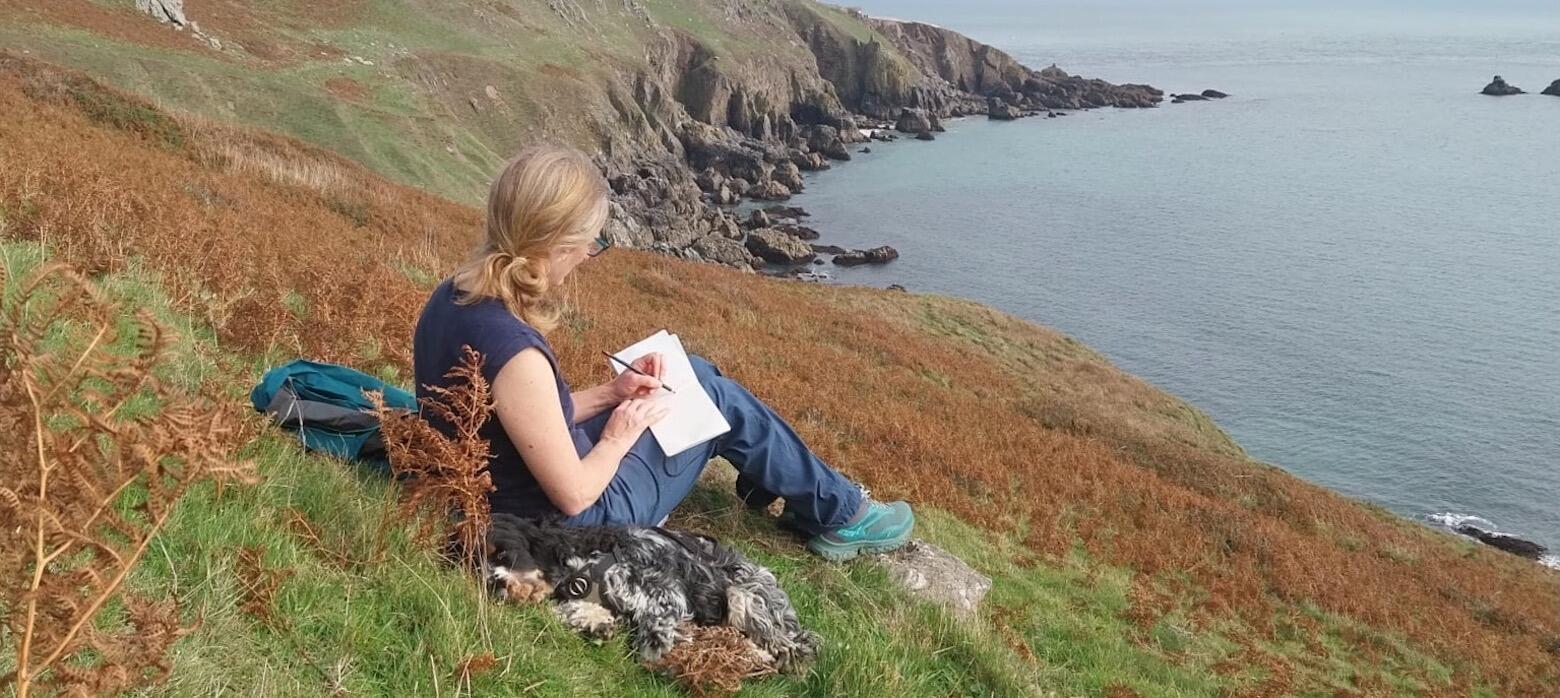
Amanda Bradbury sketching in the field
Amanda Bradbury, A flight of Swallows, Wire, 80x107x12cm
Brent Bauer, South Channel garden, Oil on board, 45x61cm
Reece Ingram, The night watchman, Carrara marble, 21x42x16cm